
 English
 العربية
 中文(简体)
 Français
 Deutsch
 Italiano
 Polski
 Português
 Русский
 Español
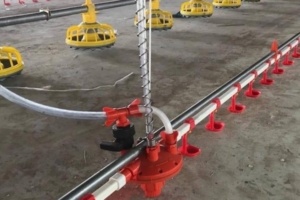
Wasserdruckregler für Geflügel: Steigerung des FCR von Broilern
In commercial broiler production, Die Rentabilität hängt vollständig vom Feed Conversion Ratio ab (FCR). Betriebsleiter wenden erhebliche Ressourcen für die Futterformulierung auf, Beleuchtungspläne, und Temperaturkontrolle. Jedoch, in unserer Praxiserfahrung, Eine kritische Variable sabotiert häufig die Effizienz der Herde: unkontrollierter Trinkleitungsdruck.
Die Wasseraufnahme beeinflusst direkt den Futterverbrauch. Broilers consume approximately 1.6 Zu 2.0 times more water by weight than feed under thermoneutral conditions. When drinking line pressure drifts out of range, birds struggle to drink efficiently, or nipples begin to leak. Installing precision poultry water pressure regulators resolves these fluid dynamics issues, directly protecting your litter quality and FCR.
The Hydraulic Link Between Water Pressure and Broiler FCR
Hydration dynamics dictate how efficiently a broiler converts nutrients. A chicken cannot swallow water via active muscular contraction in the throat; stattdessen, it relies on gravity and precision nipple actuation. If static line pressure is improperly calibrated, flock performance drops through two distinct mechanical failures.
High Pressure: Floor Spillage and Litter Degradation
When pressure exceeds operational thresholds, the water velocity at the nipple pin becomes too high. As a chick depresses the trigger pin, water sprays forcefully past its mouth rather than dripping smoothly onto its tongue.
- Litter Caking: Spilled water saturates the wood shavings or rice hulls beneath the drinking line.
- Ammonia Production: Damp litter combined with uric acid in droppings accelerates ammonia release (NH₃), irritating the respiratory tract and eye membranes.
- Footpad Dermatitis: Constant contact with wet bedding causes pododermatitis (footpad lesions), decreasing bird mobility and reducing feed access.
Low Pressure: Dehydration and Feed Stagnation
Conversely, insufficient line pressure starves the end of the line. Broilers require quick, easy water access after eating dry pellets.
- Reduced Feed Intake: If a bird cannot obtain sufficient water within 15 Zu 20 seconds at the drinker, it stops eating.
- Flock Ununiformity: Dominant birds crowd the front of the line where pressure is highest, leaving weaker birds at the end of the barn dehydrated and underweight.
Pressure Calibration Across Growth Cycles
Während der Farminstallation, we emphasize that water pressure is not a static parameter. As broilers mature from day-old chicks to market weight, their drinking force and volume requirements increase substantially.
Day 1 to Day 7 (Brooding Phase)
Day-old chicks possess minimal physical force to actuate a nipple pin. Static line pressure must remain low to prevent high pin resistance.
- Riser Tube Column Height: Pflegen 10 Zu 15 cm (4 Zu 6 Zoll).
- Target Pin Flow: 20 Zu 25 ml/min. A light touch on the trigger stem must release a small droplet on the pin tip without spraying.
Week 2 to Market Weight (Grow-Out Phase)
As birds grow, their water volume demand expands rapidly. Increasing line pressure raises the water column inside the line, delivering more volume per second of pin deflection.
- Week 2 (Day 8–14): Set riser tube height to 20 Zu 30 cm for a flow rate of 40 Zu 50 ml/min.
- Week 3 to Market: Gradually increase riser tube height from 35 Zu 50 cm (14 Zu 20 Zoll) to achieve a flow rate of 60 Zu 90+ ml/min.
- Operational Check: The riser tube’s high-visibility float ball provides a quick visual reference for farm managers during daily barn walks.
Evaluating System Dynamics: Regulators vs. Gravity Tanks
Most commercial farms in Europe, Asien, and the Americas have phased out traditional gravity header tanks in favor of inline pressure regulators integrated into an automatic poultry drinking system.
- Pressure Stability: Inline regulators maintain exact set pressure regardless of main supply fluctuations, whereas gravity tanks experience pressure changes as the internal water level rises or falls.
- Flushing Capability: Inline systems support high-pressure pass-through flushes in seconds. Gravity tanks require manual draining, pipe disassembly, or manual tank scrubbing.
- Biosecurity: Enclosed inline regulators prevent airborne dust, feather debris, and pathogens from entering the drinking line.
- Arbeitsbedarf: Pressure adjustments are made using a single control knob at the line intake, eliminating the need to physically raise or lower heavy overhead tanks.
Engineering Setup and Field Installation Logic
Installieren eines Wasserdruckregler für die Trinkwasserleitung requires careful attention to line length, slope, and intake filtration. Incorrect placement compromises the regulator’s internal diaphragm.
- Control Manifold Sequence
Position the regulator downstream from main water filtration units, water meters, and chemical dosing pumps (medicators). Placing an unfiltered water supply directly into a regulator allows sand, Rost, or pipe scale to lodge underneath the internal diaphragm seat, causing persistent line weeping. - Managing Slope in Long Barns
In houses longer than 100 Meter, floor slope creates hydrostatic head pressure. For every 10 cm of floor drop, water pressure inside the pipe increases by 1 cm of water column height.
- Level Floors: Install a single regulator at the intake end of the drinking line.
- Sloped Floors (> 30 cm drop): Install mid-line pressure breakers or secondary regulators along the line to cancel out gravity-induced pressure accumulation.
- Integrated High-Pressure Flushing
Biofilm buildup inside drinking pipes is a primary cause of leaky nipple pins and bacterial spread. Modern regulators feature a dual-mode valve:
- Regulation Mode: Low-pressure output for daily drinking.
- Flush Mode: Bypasses internal regulation springs, sending high-pressure water (1.5 Zu 2.0 Bar) down the line to purge sediment, organic biofilm, and supplement residue.
StoutAgri Hydration Engineering Solutions
StoutAgri designs and manufactures complete poultry watering infrastructure built to withstand demanding commercial barn environments.
Dual-Outlet Heavy-Duty Regulators
Our specialized Wasserdruckregler für die Trinkwasserleitung features a high-impact ABS housing and stainless steel internal fasteners. Designed for high-density facilities, a single StoutAgri regulator unit can feed water simultaneously to two parallel nipple lines up to 120 meters in length.
Complete Line Integration
To maximize flock performance, pair our regulators with StoutAgri’s full line of poultry equipment:
- Automatisches Geflügeltränkesystem: Precision stainless steel 360-degree nipples paired with rigid PVC support pipes and anti-roost wire.
- Automatisches Geflügelfütterungssystem: High-capacity pan feeders engineered to work alongside our drinking lines for balanced feed and water access.
- Drinking Line Hand Winch & Pulley Systems: Heavy-duty winching hardware allowing precise ceiling-height adjustments as birds grow.
Optimize Your Poultry House Performance
Properly calibrated poultry water pressure regulators are essential for maintaining dry litter, protecting flock health, and achieving optimal feed conversion ratios. By taking control of your barn’s fluid dynamics, you eliminate hidden water waste and support uniform bird growth across every batch.
- Discuss Your Project Requirements: Contact the StoutAgri engineering team today to review your poultry house plumbing layout and select the correct regulators for your lines.
- Request a Quotation: Looking for reliable bulk supplies for a new barn build or distribution network? Request a customized quotation on our complete drinking line systems today.