
 English
 العربية
 中文(简体)
 Français
 Deutsch
 Italiano
 Polski
 Português
 Русский
 Español
Chain Feeding System vs Auger Feeding System: Which Should You Choose?
For most large-scale pig farms in the United States, a Chain Feeding system offers better feed consistency, lower maintenance costs, and more stable long-distance feed delivery than an auger system. In farms with 2,000 to 5,000 pigs, chain systems usually perform better in multi-building layouts and long feeding circuits. However, auger systems still fit some compact pig houses with shorter feed lines and lower initial budgets.
In our field experience, commercial farms in the United States increasingly choose centralized chain feeding layouts because they reduce feed separation and improve feed flow stability. Moreover, chain systems handle powder feed and pellet feed more consistently in long-distance transport conditions.
How the Two Systems Work
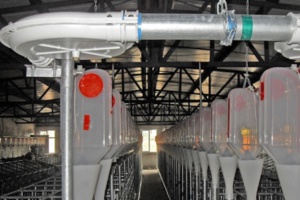
A Chain Feeding system moves feed through galvanized pipes using a chain disc assembly. The motor drives the chain continuously through the feeding circuit. Feed travels evenly across the entire line and returns to the hopper after circulation.
An auger feeding system uses a rotating spiral auger inside PVC or steel pipes. The screw pushes feed forward until it reaches the drop feeders.
In practice, both systems automate feed delivery. However, their performance changes significantly when farm size increases.
For example, many United States pig farms now use feeding loops exceeding 250 meters. Under these conditions, chain systems generally maintain more stable feed distribution.
Feed Delivery Distance and Layout Efficiency
Distance is one of the biggest differences between the two systems.
A typical Chain Feeding system can transport feed 250–400 meters with multiple corners. Most commercial installations support 4 to 8 bends without major feed flow reduction.
On the other hand, auger systems usually perform best within 60–120 meters. Longer layouts often increase motor load and feed grinding.
In a 3,000-head finishing farm, feed distribution consistency improved by approximately 10–15% after replacing a long auger line with a chain circuit. As a result, feeder variation decreased across different pens.
Commercial standards in the United States show that larger integrated farms prefer centralized feed circuits because they simplify management across multiple barns.
Feed Quality and Waste Control
Feed particle integrity matters in pig production. Excessive grinding creates dust and increases feed waste.
A Chain Feeding system moves feed with less crushing force. Therefore, pellet quality remains more stable during transport. In addition, less dust accumulation improves feeding conditions inside enclosed barns.
Auger systems generate more friction. As a result, fine particles increase over time, especially in long delivery lines.
In our field experience, farms switching from auger systems to chain systems often reduce visible feed waste by 8–12%. According to the FAO livestock management guidelines, reducing feed waste directly lowers operating costs and slurry volume in commercial farms. Moreover, workers spend less time cleaning spilled powder around feeders.
For dry feeding systems, chain circuits also improve feed uniformity between pens. Proper feeder adjustment also plays an important role. Poorly adjusted pig feeders often increase feed waste inside finishing barns. This becomes important in finishing operations where consistent feed intake affects FCR performance.
Installation and Technical Considerations
System layout directly affects operational stability.
For most Chain Feeding system installations:
- Feed pipe diameter: 45 mm or 60 mm
- Motor power: 1.5–2.2 kW
- Recommended chain speed: 36 meters per minute
- Hopper angle: 60 degrees minimum
- Maximum circuit distance: approximately 400 meters
For auger systems:
- Typical auger diameter: 55–90 mm
- Motor power: 1.1–3 kW
- Recommended straight-line layout
- Fewer bends recommended
In practice, chain systems require more precise installation alignment. However, once installed correctly, daily maintenance remains relatively simple.
Many farms install tension adjustment units every 80–100 meters to maintain stable chain operation. In addition, pressure-sensitive safety switches help prevent overload damage.
Which System Is Better for Large Pig Farms?
For farms under 800 pigs with short feed lines, auger systems remain a practical option because initial investment costs stay lower.
However, for large-scale pig farms in the United States, a Chain Feeding system usually provides better long-term operational efficiency.
The advantages become clearer when farms:
- use multiple barns
- require long feed transport distances
- operate centralized feed silos
- focus on reducing labor costs
- need consistent feed delivery
Moreover, chain systems often reduce maintenance interruptions caused by feed bridging and auger wear.
In our field experience, farms planning future expansion should avoid undersized feeding layouts. Feed systems normally remain in operation for more than 10 years. Therefore, scalability matters from the beginning.
Common Installation Mistakes
Many feeding problems result from poor installation planning rather than equipment quality.
Common issues include:
- excessive pipe bends
- undersized motors
- incorrect hopper slope
- unstable pipe support spacing
- poor feed return alignment
For example, some farms place too many 90-degree corners in compact layouts. As a result, motor load increases and chain wear accelerates.
Proper support spacing should remain within 1.5–2 meters to reduce pipe vibration during operation.
FAQ
Is a Chain Feeding system better for large pig farms?
Yes. For most large-scale pig farms, chain systems provide more stable feed transport over long distances and improve feed consistency between barns.
Do auger systems cost less initially?
Yes. Auger systems usually require lower initial investment for smaller farms with simple layouts.
How far can a Chain Feeding system transport feed?
Most commercial systems operate effectively between 250 and 400 meters depending on feed type and layout design.
Which system creates less feed dust?
Chain systems generally create less feed grinding and lower dust levels during transport.
Conclusion
For modern large-scale pig farms in the United States, a Chain Feeding system usually delivers better long-term value than an auger system. It improves feed consistency, supports longer transport distances, and reduces feed waste under commercial operating conditions.
Auger systems still fit smaller farms with compact layouts. However, as farm size increases, chain systems provide stronger operational stability and easier expansion planning.
Contact StoutAgri for a technical consultation.
Request a quote for your specific farm layout.